Characterization Service
Transducer Characterization
Full broadband beam profiles in a single scan — 0 to 5 MHz at 0.1 mm resolution. No couplant, no water tank, no repeat scans at different frequencies.
Why BROADSONIC Characterization
Broadband Data in One Scan
A single BROADSONIC scan captures the complete 0–5 MHz spectrum at every spatial point, so frequency-specific maps can be explored after the measurement.
0–5 MHz Bandwidth
Full broadband spectrum captured at every pixel in a single pass. No frequency pre-selection required.
0.1 mm Resolution
100 μm spatial resolution from a single-point optical sensor. Resolve fine beam structure that larger sensors blur out.
Minutes per cm²
Fast enough for rapid engineering comparisons. Reports are delivered within two weeks of receiving a scan-ready device.
Non-Contact
No couplant, no water tank, no loading effects on the transducer under test. Measures the actual radiated acoustic field in air.
What You Get
Spatial Acoustic Field Maps
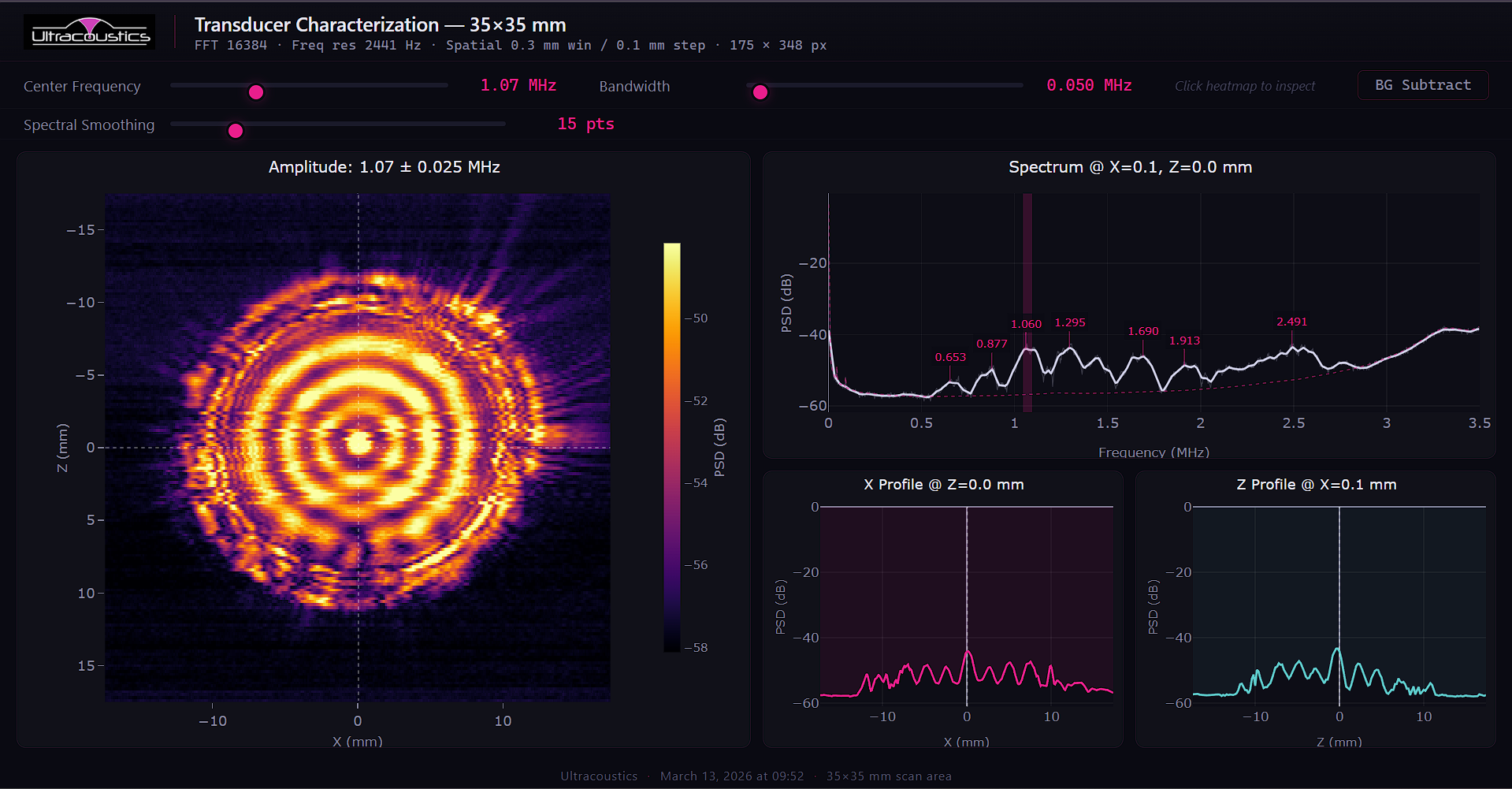
2D amplitude maps at any frequency of interest across the 0–5 MHz band. Each scan pixel contains a full frequency spectrum, so maps can be reconstructed at any frequency in post-processing. No need to decide on frequencies before scanning.
Interactive Reports — No Software Required
Results are delivered as a browser-based interactive HTML report that opens in any browser with zero software installation. Unlike proprietary analysis tools that lock data behind expensive licenses, our reports are fully self-contained and shareable.
- Spatial amplitude maps at any user-selected frequency across the 0–5 MHz band, with a frequency slider for real-time exploration
- Per-pixel spectrum viewer: click any point on the spatial map to see its full frequency spectrum
- Color scale controls for adjusting dynamic range and visualization
- Exportable raw data in standard formats for further analysis in your own tools
Share reports with colleagues and customers — anyone with a browser can explore the data themselves.
Measurement Specifications
| Bandwidth | 0–5 MHz, single pass |
| Scan Area | Standard evaluation: up to 35 × 35 mm; larger areas up to 20 × 20 cm by quote |
| Spatial Resolution | Down to 0.1 mm (100 μm) |
| Scan Speed | Minutes per cm² at fine resolution |
| Contact | None — air-coupled, no couplant |
| Excitation | Sine, pulse, or noise up to 20 V; higher-voltage or multichannel devices require a compatible manufacturer-supplied driver |
| Turnaround | Confidential interactive report within two weeks of receiving a scan-ready device |
Supported Transducer Types
- Single-element piezoelectric transducers
- Phased arrays and multi-element transducers with compatible drive and connection hardware
- CMUTs and PMUTs
- Focused transducers
Process
How It Works
Define the Question
Tell us about one transducer and the engineering question you want the scan to answer. We confirm drive, connection, fixture, and scan compatibility first.
Ship Your Transducer
Send the accepted device to Ultracoustics in Edmonton, Alberta. Mutual NDA terms are available.
We Scan It
BROADSONIC and a precision translation stage capture the broadband spatial acoustic field.
Review the Result
Receive the confidential interactive report and standard data exports within two weeks. Return shipping is included for accepted strategic evaluation scans.
Current Program
In Active Manufacturer Evaluation
Ultracoustics is currently completing a government-funded pilot with AIMS/PIP360, a manufacturer of industrial ultrasonic sensor arrays. Pilot results and technical details remain confidential.
See It In Action
Scanning a Transducer Beam Profile
A BROADSONIC sensor mounted on a precision translation stage scans the acoustic field of an ultrasonic transducer point-by-point. The full 0–5 MHz spectrum is captured at every position in a single pass.
Why This Application Exists
BROADSONIC provides a complementary view for development teams that need to understand the field radiated into air.
Hydrophone Scanning
Hydrophone mapping generally requires immersion, careful alignment, and a sensor selected and calibrated for the relevant frequency and pressure range. BROADSONIC measures the radiated field in air without a tank, couplant, or acoustic loading of the transducer face.
Laser Vibrometry
Provides high-resolution surface-motion measurements but requires direct optical access to the transducer face. BROADSONIC measures the field after it has radiated into air.
Conventional Air-Coupled Microphones
Most are optimized for audio or lower ultrasonic frequencies. BROADSONIC extends air-coupled measurement across a usable bandwidth up to 5 MHz.
Industries
Who Uses This
Transducer Manufacturers
Compare prototypes, build revisions, and unexplained outliers.
NDT Equipment Companies
Validate transducer performance and uniformity.
Research Groups
Characterize custom or prototype transducers — CMUTs, PMUTs, phased arrays.
Medical Ultrasound
Beam profile data for regulatory submissions or design validation.
Proof of Capability
Explore a Real Scan
Spatial acoustic field scan of a 1.5 MHz transducer at 0.1 mm resolution. Each pixel contains a full frequency spectrum across the 0–5 MHz band. Click to explore the interactive report.
Open Interactive Report →Supporting Research
Non-Contact Characterization of Plates Using a Turbulent Air-Jet Source and an Ultrasound Microphone
Download PDF →Resonant Ultrasound Spectroscopy Detection Using a Non-Contact Ultrasound Microphone
Download PDF →Air-Coupled Ultrasound Using Broadband Shock Waves from Piezoelectric Spark Igniters
Download PDF →FAQ
Frequently Asked Questions
Hydrophone mapping generally requires immersion, careful alignment, and a sensor selected and calibrated for the relevant frequency and pressure range. BROADSONIC captures the radiated field in air without a tank, couplant, or acoustic loading of the transducer face.
Single-element piezoelectric transducers, focused transducers, CMUTs, PMUTs, and compatible phased-array or multi-element devices can be considered. The transducer must radiate measurable acoustic energy into air within the 0–5 MHz band. Higher-voltage and multichannel devices require a suitable manufacturer-supplied driver and connection information.
After confirming the scan geometry, excitation, connectors, and engineering question, you ship the device to Ultracoustics in Edmonton, Alberta. You receive a confidential interactive report and standard data exports within two weeks of our receiving a scan-ready device.
No. Results are delivered as a self-contained, browser-based interactive HTML report that opens in any web browser with zero software installation. Reports include spatial amplitude maps, per-pixel spectrum viewer, color scale controls, and exportable raw data.
One Transducer. One Engineering Question.
Tell us about the device, its drive requirements, and what you need to learn. We will confirm measurement compatibility and recommend the right scan.